
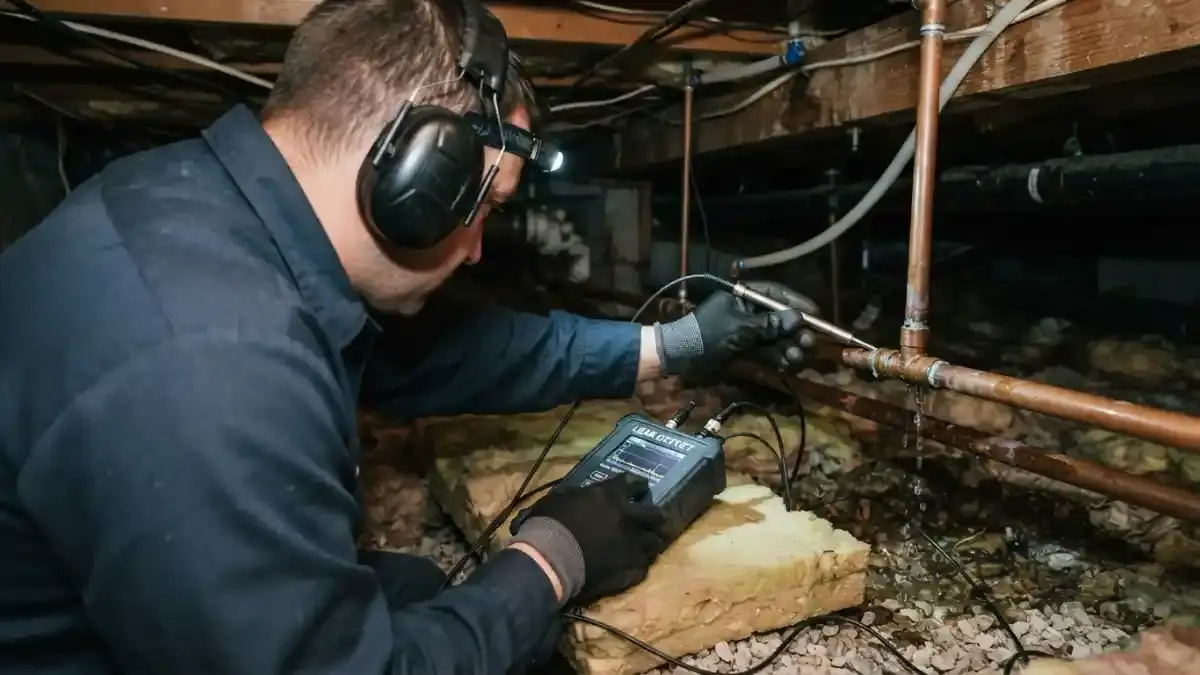
A hidden leak is one you cannot see, such as a pinhole in a copper line behind a wall or a crack under a slab. Acoustic leak detection uses sensitive microphones and ground sensors to hear the hiss of water escaping under pressure. The goal is to find the leak within a small area so the repair opens one patch of drywall or floor and not ten.
This guide explains how the method works, what it does well and where it struggles. It also shows how to confirm you have a hidden leak before paying for a visit.
How acoustic detection works
A leaking pressurized pipe vibrates and makes a sound, often too faint for a person to hear. The plumber places a sensitive probe or a ground microphone against pipes, walls or the floor and listens through headphones. The sound is loudest closest to the leak, so moving the sensor along the line narrows the location.
A correlator can pair two sensors on a pipe and calculate the leak position from the time the sound takes to reach each one. That is useful on long runs where a person cannot cover the ground by ear alone.
Confirm you have a hidden leak first
- Turn off every fixture. Make sure no taps, showers, dishwasher, washer or ice maker is running.
- Read the water meter. Write down the meter reading, wait an hour without using water and read it again.
- Check the leak indicator. Most meters have a small triangle or dial that spins when any water moves. If it turns with everything off, water is going somewhere.
- Check the toilets. Use the dye test to rule out a silent toilet leak before you pay for a visit.
- Look for signs. Warm spots on a floor, a damp smell, peeling paint or a musty corner can point to the area.
Acoustic detection compared with other methods
| Method | Best at | Limits |
|---|---|---|
| Acoustic listening | Pressurized supply leaks in metal pipe | Quiet leaks in plastic pipe and noisy environments can be hard to read |
| Thermal imaging | Hot water leaks and radiant heating lines | Needs a temperature difference to show up |
| Tracer gas | Small leaks that are hard to hear | Needs the line to be isolated and filled |
| Pressure testing | Showing which line is losing pressure | Does not give a location |
| Moisture meters | Confirming damp materials | Shows moisture, not the source |
Most visits use more than one tool. A plumber might pressure test to find which line is leaking, listen to narrow it down and use a moisture meter or thermal camera to confirm before cutting. Our leak detection page shows how this combines in practice.
It finds leaks in pressurized lines. It does not find a slow drain leak, a roof leak or condensation. A plumber will tell you which method fits the symptom before starting.
What a visit looks like
- The plumber asks what you saw, when it started and what the meter shows.
- The water is isolated by zone if possible, so the leak can be narrowed to a branch.
- Sensors are placed along the pipe path or on the floor, and the plumber listens and marks.
- The plumber confirms the spot with a second method and shows you the marked area.
- The wall or floor is opened in one place, and the leak is repaired.
If the leak is in a main line under the slab, the repair may go from a small access hole to rerouting a section of pipe. For homes with repeated leaks in old copper or galvanized lines, repiping may be worth a conversation after the second or third repair.
What a hidden leak costs if you wait
Water that escapes inside a wall or under a slab does damage quietly. It soaks insulation, feeds mold and can undermine flooring long before a stain shows. A small leak that runs for weeks is often worse than a burst pipe that gets fixed in an hour, because nobody noticed it.
That is why a spinning meter with every fixture off deserves a call the same week you notice it. The sooner the leak is located, the smaller the opening the repair needs.
Local notes for Shakopee homes
Shakopee Public Utilities states that the homeowner is responsible for the service line from the house out to the connection with the main, and for all water used including leaks. A hidden leak outside the house can therefore be the owner's to repair, and it shows up on the bill first.
The same utility lists water at 21 grains per gallon. Mineral scale builds inside supply lines over time, and it can contribute to pinholes and narrowed pipes in older homes.
The utility also publishes a lead service line inventory. If your home is older, it is worth asking the utility what your service line is made of when a leak or repair brings the topic up.
Source type: Shakopee Public Utilities residential water page and lead service line inventory
Questions to ask before you book
Before a detection visit
- Which tools will you use, and what happens if the first one does not find it?
- Will you mark the spot and show me before cutting?
- What is the plan to repair the leak once you find it?
- Do you patch the opening, or is that a separate trade?
- What does the visit cost if no leak is found?
We serve homes across the south metro on the same 24/7 line, including Eden Prairie and Chaska. If water is already spreading, shut off the main first.
Repairs after detection follow the Uniform Plumbing Code (UPC) as adopted in Minnesota Rules chapter 4714.
Questions we hear
Usually the plumber narrows the location without cutting and then opens one small area. Some leaks need a second method to confirm before any cutting.
It can, but plastic carries sound poorly, so it can be harder to pinpoint. Other methods may help.
Shut off the main at the house. If the meter still moves, the leak is between the meter and the house shutoff, which in Shakopee is the homeowner's side of the line.
Yes. A sudden jump with no change in use is one of the earliest signs, because the utility bills for all water used including leaks.
It can be, if the inspector sees staining or low pressure. Ask your inspector first.
Not sure which answer fits your situation? Call the 24/7 line and describe what you see.