
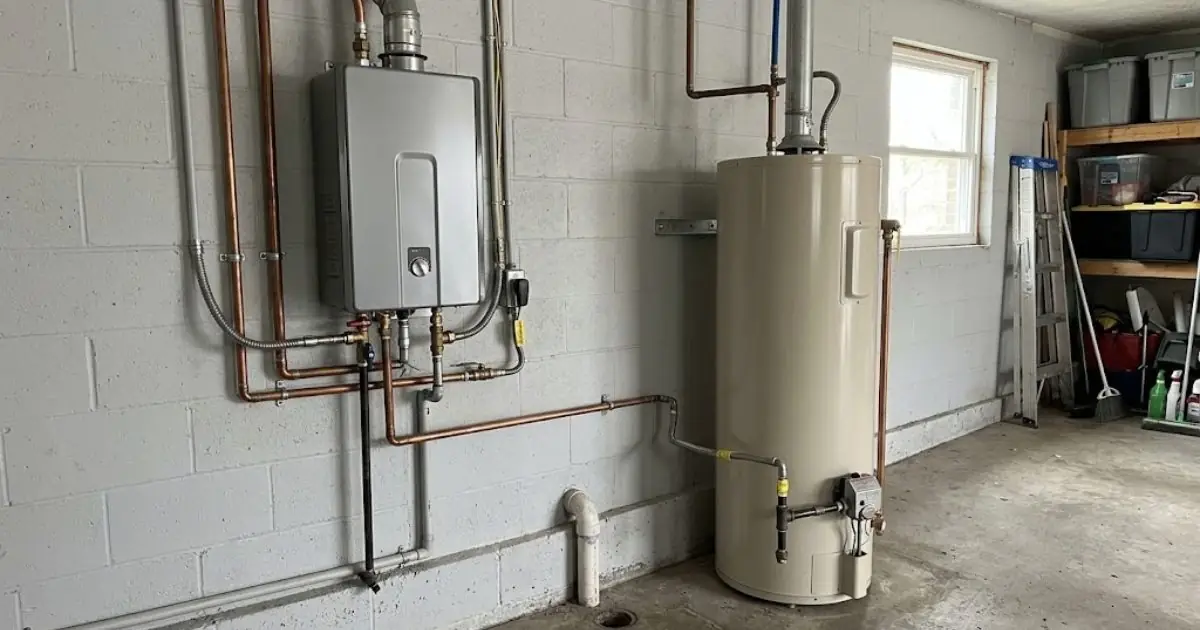
A tankless water heater heats water as it flows instead of storing it, so it can deliver hot water for as long as the burner or elements run. In Shakopee the city water is very hard, which makes scale control the most important part of owning one.
Descaling is the service most owners miss
Shakopee Public Utilities lists the city water at 21 grains per gallon. Scale forms on the inside of a tankless heat exchanger when hot water passes through, and it narrows the flow and makes the unit work harder. Owners often first notice an error code, fluctuating temperature or a longer wait for hot water.
A flush uses a small pump, a bucket and a mild descaling solution to circulate through the unit and dissolve scale. Many manufacturers suggest annual service in hard water areas, and some warranties expect it. The plumber will read your model instructions before touching the unit.
Signs a tankless unit needs a flush
- Hot water turns lukewarm or swings in temperature.
- An error code appears on the display, often tied to flow or temperature.
- The unit sounds louder or kettles as it runs.
- Flow at the faucet is weaker than before.
- It has been more than a year since the last descale.
Installing a tankless unit
A tankless swap changes more than the heater. Gas models often need a larger gas line and a stainless vent, and electric models can need a heavy circuit. The plumber will measure your largest simultaneous hot water use, such as a shower and a dishwasher together, and size the unit to that peak.
| Item | Tank heater | Tankless heater |
|---|---|---|
| Hot water supply | Limited by tank size | Continuous while running |
| Floor space | Larger footprint | Wall mounted, smaller |
| Install scope | Usually a straight swap | Gas line, vent or circuit may change |
| Hard water care | Flush the tank yearly | Descale the heat exchanger yearly |
Minnesota winters also affect incoming water temperature, which is cold, so a unit has to raise it more than the same unit would in a warmer state. That affects how many fixtures it can serve at once, and it is why sizing deserves a real calculation.
Repairing tankless units
Common repairs include clearing a blocked inlet filter, replacing a flow sensor, cleaning a scaled heat exchanger, and resetting a vent or ignition fault. Error codes are model specific, so the plumber looks up the code before guessing. Some failures, such as a cracked heat exchanger, are not worth repairing on an older unit.
Pairing a tankless unit with a softener
A water softener upstream greatly reduces scale and makes tankless ownership easier in a very hard water area. Salt-based softening adds sodium, and you should check any warranty rules about water chemistry. Our water softener installation page covers that side.
Tankless from the replacement side
If you are choosing between a new tank and a tankless unit after a failure, the replacement page shows how a standard tank swap compares. If your current tank is still working, installation planning gives you more time to decide.
What affects tankless cost
You get a clear price before work starts. Insurance does not usually cover wear from scale, so keep service records because they can matter for the warranty. Want your real number? Call the 24/7 line.
Gas, venting and condensate for a tankless unit fall under the Uniform Plumbing Code (UPC) as adopted in Minnesota Rules chapter 4714, along with the manufacturer's own instructions.
Tankless questions
Many manufacturers suggest once a year, and very hard water makes that more important. Check your model manual and keep a record of each flush.
Often yes. Scale is a common cause of flow and temperature errors, and a flush can clear it. The plumber looks up the code first to rule out other faults.
Yes, but the incoming water is colder, so a unit has to work harder to reach the set temperature. Proper sizing makes sure it keeps up when several fixtures run.
It is not required but it is strongly advised in very hard water. Scale is the main cause of tankless service calls in an area like Shakopee.
The 24/7 line is open for failures, and a plumber is dispatched for a no-hot-water call. Planned install and descale work is booked in regular hours.
Not sure which answer fits your situation? Call the 24/7 line and describe what you see.