
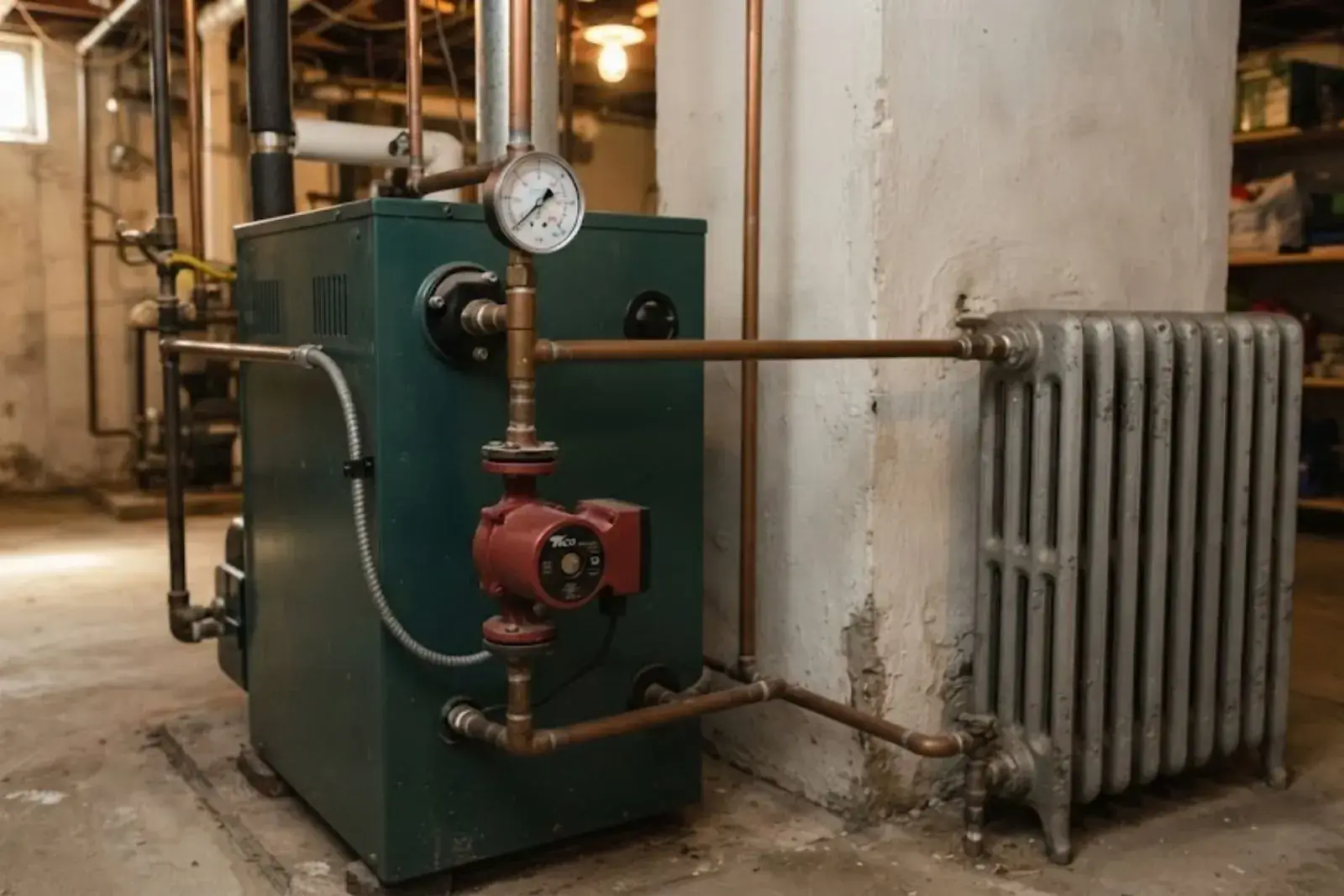
Heat that goes out in January is an emergency in Minnesota, because a cold house can freeze pipes within hours. Our 24/7 line dispatches a plumber for hot water boilers that will not fire, leak or hold pressure. If you smell gas or a carbon monoxide alarm sounds, leave the house first and call the gas utility or 911 from outside.
No heat: what to check before the call
Quick checks that help the plumber
- Confirm the thermostat is on heat and calling for it, and replace its batteries.
- Check the boiler switch and the breaker or fuse for the boiler.
- Look at the pressure gauge and compare it with the range on the boiler label.
- See whether the pilot or display shows a fault code, and write it down.
- Look for water at the base, pipes or valves.
A hot water boiler heats water and sends it through pipes to radiators, baseboard or in-floor heating. It runs a closed loop, so problems usually come from pressure, a failed circulator pump, a blocked burner, a bad sensor or an air-bound system.
Common boiler faults
| Symptom | Likely cause | Typical repair |
|---|---|---|
| No heat, boiler off | Failed control board, ignition fault or tripped safety | Reset or replace the faulty part |
| Boiler runs, radiators cold | Failed circulator pump or air in the loop | Replace pump or bleed the system |
| Pressure drops or spikes | Leak, failed expansion tank or bad fill valve | Fix leak, replace tank or valve |
| Banging or kettling | Scale or sludge on the heat exchanger | Flush the system and clean the exchanger |
| Water dripping from relief valve | Pressure too high or a failing valve | Find the cause and replace the valve |
Radiators and older systems
Many older Minnesota homes still use cast iron radiators fed by a hot water boiler. Those systems can run for decades but depend on working valves, air vents and a sound expansion tank. A radiator that heats only at the bottom or gurgles often has trapped air, and the plumber bleeds it as part of the visit.
Boiler pressure and the relief valve
Every boiler has a pressure relief valve that opens if pressure climbs too high. If it drips, do not cap it. That drip is a warning that the system is overpressured, the expansion tank has failed, or the valve itself is worn. A plumber diagnoses which and replaces the part.
Diverter and zone valves
Some systems use zone valves or diverter fittings to direct hot water between heating zones or between heating and a domestic hot water coil. A stuck valve can leave one zone cold while another overheats. These are replaceable parts, and a plumber confirms the wiring and flow before replacing one.
Hard water, scale and boilers
A closed boiler loop does not keep taking in fresh water, so scale from the city supply is less of a problem there than in a water heater. A leaking system that keeps adding fresh makeup water does bring in minerals each time. Shakopee Public Utilities lists the city water at 21 grains per gallon, so fixing the leak is worth more than topping off.
When to repair and when to replace
- Repair when the boiler is under about 15 years old and the fault is a single part.
- Replace when the heat exchanger is cracked or leaking internally.
- Replace when repairs repeat within a season, or when parts are no longer made.
- Ask about efficiency when the boiler is over 20 years old and repairs are large.
What affects boiler repair cost
The plumber gives you the price before replacing a part. Most home policies do not pay to repair a boiler that failed from age, but can cover water damage from a sudden leak. Annual service helps catch failures before cold weather. For a hot water supply problem without a heating issue, see water heater repair.
Boiler piping, relief valves and the domestic water side follow the Uniform Plumbing Code (UPC) as adopted in Minnesota Rules chapter 4714, while gas and combustion rules add their own requirements.
What to do if the boiler stops heating
- Check the thermostat, the power switch and the pressure gauge.
- Do not open the boiler casing or touch the gas valve.
- If you smell gas, leave the building and call 911 and the gas utility.
- Open cabinet doors on outside walls and keep the house warm until help arrives.
Boiler questions
Yes. The 24/7 line takes no-heat calls on nights, weekends and holidays, and a plumber is dispatched to your address. In winter, say whether the house is losing heat quickly.
Leave the house, avoid switches and flames, and call the gas utility or 911 from outside. Call us after the gas company has cleared the building.
A leak somewhere in the loop, a failing expansion tank or a bad fill valve can cause it. The plumber checks all three.
Trapped air, scale or low water in the system. Bleeding the air or flushing the boiler usually helps.
Smaller commercial hot water boilers can be handled by a plumber. Larger systems may need a specialty contractor, and we will tell you so on the call.
Not sure which answer fits your situation? Call the 24/7 line and describe what you see.