
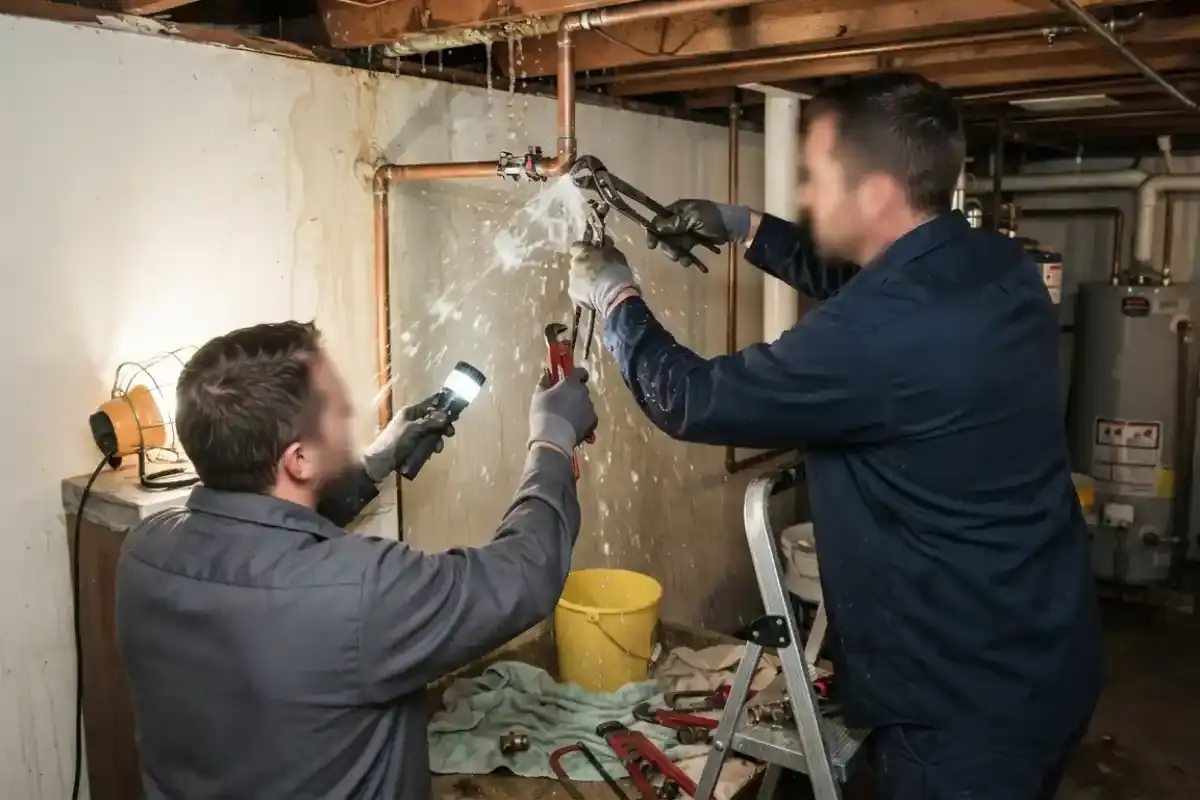
When a pipe bursts: the first five minutes
- Shut the main water valve. It is usually near the meter or where the line enters the house. Turn it clockwise until it stops.
- Kill power to the wet area. Switch off the breaker for rooms with water near outlets, and stay out of standing water if the panel is wet.
- Open a low faucet. This drains the line and relieves pressure so water stops flowing from the break.
- Save what you can. Move furniture and papers up and away, and take photos before cleaning up.
- Call the 24/7 line. A plumber can be dispatched at any hour, and the dispatcher explains timing on the call.
Burst pipe repair means stopping the water, finding the failed section and replacing it with a sound piece of pipe and fittings. A small split may be repaired with a coupling, but a long split or corroded run is better replaced to avoid a second break nearby.
Frozen pipes in Minnesota
Pipes freeze when cold air reaches them in exterior walls, attics, crawl spaces, garages and unheated basements. The pipe usually does not burst where it freezes, but where trapped pressure builds between the ice and a closed faucet. Water appears when the ice thaws.
If you find a frozen pipe that has not burst, open the faucet it feeds and warm the pipe slowly with a hair dryer or warm towels. Never use a torch. If you see any crack or wet spot, shut the main and call. Shakopee Public Utilities notes that water used because of frozen pipes remains the homeowner account responsibility, so stopping a break fast also limits the bill.
Why pipes break
Ice expands and splits the pipe, usually in a cold wall or an unheated space.
Old galvanized and thin copper develop pinholes and weak spots.
A pressure surge or water hammer can fail a weak joint.
A nail, screw or shovel can pierce a pipe in a wall or yard.
Repair by pipe material
| Material | Common repair | Notes |
|---|---|---|
| Copper | Cut out the section, solder in new pipe and fittings | Pinholes in older runs often mean replacing more than one spot |
| PEX | Cut and use crimp or expansion fittings | PEX can handle some freeze expansion but fittings can still fail |
| PVC and CPVC | Cut and replace with solvent-welded sections | Cold makes plastic brittle |
| Galvanized steel | Replace the run, often with PEX or copper | Many failures suggest repiping |
What happens after the water stops
A burst pipe is only part of the problem, because wet drywall and insulation can grow mold within a couple of days. The plumber stops the leak and repairs the pipe, then you start drying. Remove wet insulation, run fans and a dehumidifier, and call your insurance company as soon as you can. For tracing a leak that is not obvious, see leak detection.
Pipe leaks that are not a full burst
A pinhole leak sprays a thin jet, and a seam or joint leak drips down a wall. Both can look minor and both can ruin drywall over weeks. If a copper pipe develops one pinhole, others are probably close behind, so the plumber may recommend replacing the run and not patching the single hole.
Preventing the next freeze
Before the next cold snap
- Insulate pipes in garages, crawl spaces and exterior walls.
- Disconnect garden hoses and shut off outdoor spigots from inside where possible.
- Keep the thermostat above 55 degrees when you are away.
- Open cabinet doors under sinks on exterior walls during hard freezes.
- Let a faucet drip slightly during extreme cold on a vulnerable line.
What affects burst pipe repair cost
The plumber gives you the price for the pipe repair before cutting into the system. Most homeowner policies cover sudden bursts and the damage that follows, but they often exclude long-term leaks, so document the date and cause with photos. We also serve Chanhassen and Chaska for burst pipe calls.
Pipe replacement after a burst follows the Uniform Plumbing Code (UPC) as adopted in Minnesota Rules chapter 4714, including approved materials and joints.
What to do before the plumber arrives
- Close the main water valve at once.
- Switch off power to wet areas at the breaker only if you can do it without standing in water.
- Open a tap on the lowest floor to drain the lines.
- Move belongings away and photograph the damage.
Burst pipe questions
Yes. Our 24/7 line is staffed every hour of every day, and burst pipes are the calls that get dispatched first. Shut the main valve and then call.
Tell the dispatcher what you see and where the meter is. A plumber can shut the main at the meter or find the house valve on arrival.
Many policies cover sudden bursts and the resulting water damage, but not slow leaks or neglect. Read your policy and call your insurer early.
Yes. A plumber thaws it slowly with approved tools and checks for cracks as the ice melts, since a hidden split shows itself once water flows.
A single failure on a sound run can be repaired. Repeated failures on old galvanized or thin copper usually mean it is time to replace the whole run.
Not sure which answer fits your situation? Call the 24/7 line and describe what you see.