
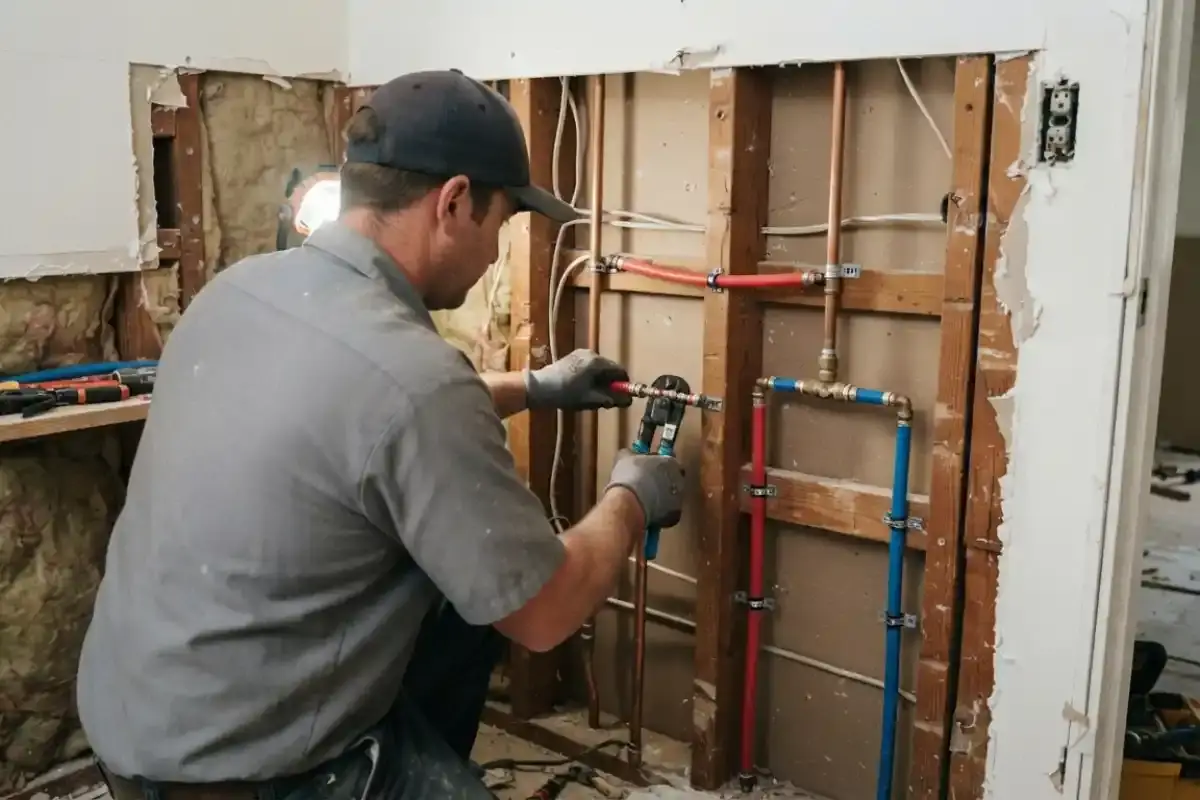
Repiping means replacing the water supply pipes in a home, either the whole system or large sections. It is the right answer when old pipe is corroding from the inside, has repeated pinhole leaks, or gives low pressure and rusty water that cannot be fixed with a patch.
Signs your pipes are at the end
A second pinhole in the same run means more are coming.
Corroding galvanized steel and iron shed rust into the water.
Scale and corrosion shrink the inside of galvanized pipe.
Green, white or flaking pipe at joints and fittings.
Often a sign of an old water heater or aging hot lines.
Polybutylene and some old fittings are known to fail.
Galvanized steel and the age of the house
Homes built many decades ago often used galvanized steel for supply lines. It rusts from inside, narrows with scale and eventually leaks. Many homes in newer parts of Shakopee, built since the city doubled in population after 1995 according to the City of Shakopee history page, use copper or PEX, which have different failure modes. A plumber can identify the material and age at a glance, and a magnet or scratch test helps.
If a section of galvanized has failed in your older house, other sections are probably close. It is often cheaper to replace the whole run than to fix one failure at a time.
Pipe options compared
| Material | Strengths | Considerations |
|---|---|---|
| PEX | Flexible, fewer joints, quick to install, handles some freeze expansion | Not for outdoor use in sunlight, and fittings must be done correctly |
| Copper | Long service life and a proven track record | Higher material cost, and soldered joints take time |
| CPVC | Lower cost for hot and cold lines | Brittle with age and impact |
In very hard water, scale can build inside copper and reduce flow over decades. Shakopee Public Utilities lists the city water at 21 grains per gallon, so a softener is worth considering alongside a repipe. See water softener installation.
How a repipe works
- Plan the scope. The plumber walks the house, marks the main and every fixture and writes a price.
- Protect the house. Floors and furniture are covered, and the water is shut off for a set period.
- Open the walls only where needed. Small access holes are cut, and PEX is routed through existing paths where possible.
- Connect and test. Each fixture is reconnected, and the system is pressure tested.
- Patch the access holes. Drywall patching is often handled separately by a contractor.
A repipe takes days for a typical house and the water is off for part of each day. Tell the plumber about people who work from home or need water at set times.
Lead, galvanized and the service line
The service line is the pipe between the water main and your house. Shakopee Public Utilities says its 2025 inventory lists 5 lead service lines, 11 galvanized lines that require replacement, and 1,288 of unknown material, and it will replace lead and galvanized-required-replacement lines at no cost to the property owner. If you are planning a repipe, ask the utility about your service line first, and let the plumber check the pipe where it enters the house.
What affects repiping cost
You get a written scope and price before the work. Insurance seldom pays for a repipe done for age, but may cover the damage from a sudden pipe failure. When a single failing pipe is the issue, burst pipe repair is the first step, and repiping comes after.
A repipe uses materials approved under the Uniform Plumbing Code (UPC) as adopted in Minnesota Rules chapter 4714, and it is the kind of project to ask the City of Shakopee about for a permit.
Repiping questions
A typical house takes a few days, and the water is shut off for part of each day. The plumber will give you a schedule when scoping the job.
Both work. PEX is faster to install and handles freezing better, while copper has a long track record. Hard water scale builds up in either over time.
Not always. If only one run is failing, you can replace that section, but repeated failures usually favor a larger scope.
Permit rules vary, so ask the City of Shakopee building inspections office. The plumber will explain what is typical.
If scale or corrosion in old pipe is the cause, yes. If the pressure problem starts at the main or the regulator, the plumber will check those first.
Not sure which answer fits your situation? Call the 24/7 line and describe what you see.