
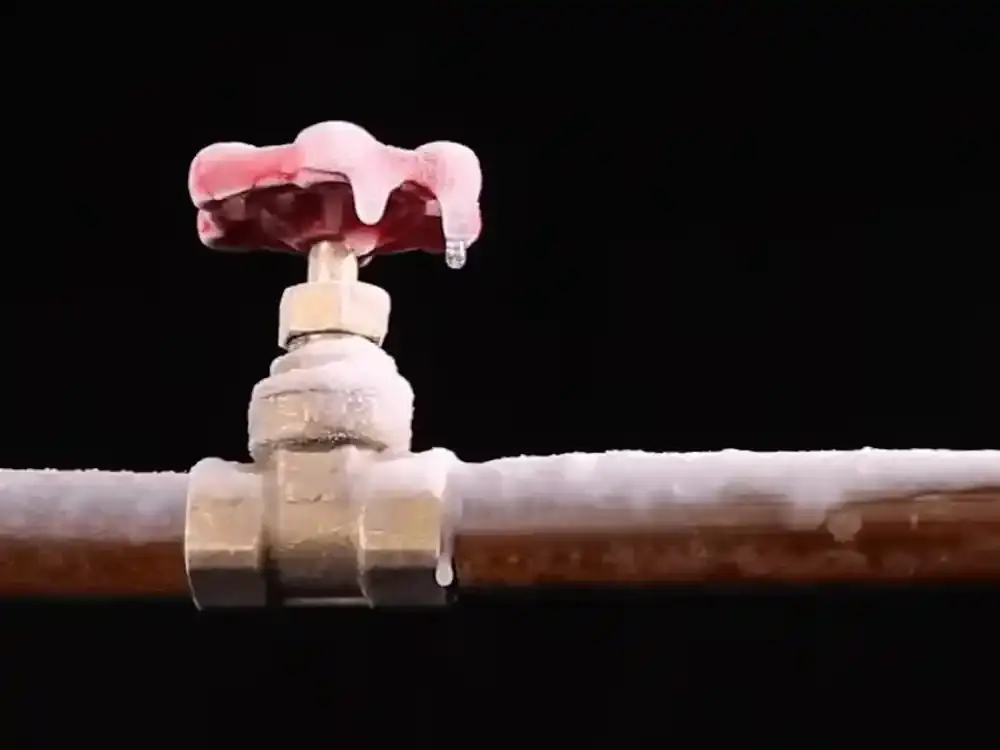
If water slows to a trickle or stops on a cold morning, a pipe may be frozen. Frozen water expands and can split a pipe, and the split is often at the freeze, not where the ice formed. The real damage appears when the ice melts and water flows through the break.
This guide covers how to tell if a pipe is frozen, how to thaw it safely and what to do if one has already burst. It also explains how to prevent the next one.
Signs of a frozen pipe
- Only a trickle or no water at one or more fixtures.
- Frost on an exposed pipe, usually along an outside wall, in a crawlspace or in an unheated garage.
- A strange smell from a drain, which can mean a frozen or blocked drain line.
- A bulge or crack in a pipe you can see.
- Water stains or dripping after a thaw, which can mean a split.
Thaw it safely in six steps
- Open the faucet. Leave the tap open so melting water and steam can leave the pipe.
- Shut off the main if you see a crack. If any section looks split or wet, close the main valve before you thaw anything.
- Find the frozen section. Follow the pipe from the dry fixture back toward the wall and look for frost or a cold spot.
- Apply gentle heat. Use a hair dryer on low, a heating pad or warm towels. Start near the faucet and work back toward the frozen area.
- Keep going until full flow returns. This can take a while. Check other fixtures for the same problem.
- Check for leaks. Once water flows, inspect the pipe, joints and the wall below for drips.
A propane torch, a heat gun on high or a kerosene heater can start a fire or damage pipes. Use gentle, even heat only, and do not leave a heat source unattended.
If a pipe has burst
Act in this order
- Close the main water valve immediately.
- Turn off power to wet areas at the breaker if water is near outlets or the panel.
- Open a tap on the lowest floor to drain the lines.
- Move belongings away from the water and photograph the damage for insurance.
- Call the 24/7 line. Our burst pipe repair page covers what happens next.
Prevent the next freeze
| Step | Why it helps |
|---|---|
| Insulate pipes in crawlspaces, garages and exterior walls | Slows heat loss from the pipe |
| Disconnect and drain outdoor hoses and shut off the exterior spigot supply | Stops water from freezing in the spigot and the line behind it |
| Seal gaps where pipes enter the house | Cold air leaks freeze pipes quickly |
| Open cabinet doors on exterior walls during cold snaps | Lets house heat reach the pipes |
| Let a faucet drip on the coldest nights | Moving water is harder to freeze |
| Keep the thermostat steady if you travel | A cold house is how pipes freeze |
For a house you leave for the winter, the safest option is to shut off the main and drain the lines. A plumber can set up the drain-down so the house can be restarted in spring. See leak detection if you find a drip after a thaw and cannot tell where it starts.
Where pipes freeze first in a Minnesota house
- Pipes inside exterior walls, especially on the north side of the house.
- Supply lines in unheated crawlspaces and garages.
- Pipes in cabinets under kitchen and bathroom sinks along outside walls.
- Outdoor hose bibs and the lines behind them.
- Water lines in basements near rim joists and drafty windows.
A quick walk through the house in November, looking for these spots, costs nothing. Insulating the worst one or two before the first hard freeze prevents most frozen pipe calls. If you find a drafty gap near a pipe, seal it with caulk or foam.
Remember that a house kept at a low temperature to save fuel can be colder inside the walls than you expect, so keep the heat steady during a cold snap.
If you are leaving the house for the winter
Set the heat no lower than the manufacturer or your plumber recommends, ask a neighbor to check the house, and shut off the water at the main if you will be gone a long time. A plumber can drain the system fully so nothing is left to freeze. A cold house with water in the lines is the setup behind most winter bursts.
Local notes for Shakopee homeowners
Shakopee Public Utilities states that the homeowner pays for all water used, including water lost through leaks and frozen pipes. A burst pipe that runs for hours therefore shows on the bill as well as in the damage.
The utility also states that the homeowner is responsible for the pipe from the house to the connection at the main. A freeze in that stretch, outside the house, is on the owner's side.
If you are not sure where your main shutoff is, find it before the cold arrives, because it is the first thing the plumber will ask about.
Source type: Shakopee Public Utilities residential water page
Do not wait for a burst
A frozen pipe that you thaw safely is a minor event. One that you ignore until a leak shows can mean hours of flooding. If you cannot find the frozen section or the thaw does not work, call for help before the ice melts into a break.
We cover Chanhassen lake homes and Chaska houses along with Shakopee, and cabin-style properties are the ones that freeze most often.
Replacement pipe after a freeze must use materials approved under the Uniform Plumbing Code (UPC) as adopted in Minnesota Rules chapter 4714.
Questions we hear
Exposed pipes can freeze when temperatures stay well below freezing for hours, and wind and gaps make it worse. Pipes in outside walls and unheated spaces freeze first.
No, but it can. Ice can split a pipe, and the leak often shows up after the thaw.
The utility bills for all water used, including leaks and frozen pipes, so the homeowner pays for the water that ran.
Yes, with gentle heat and an open faucet. If you see a crack, shut off the main and call a plumber.
On a very cold night it can help, because moving water freezes less easily. Choose a faucet on an exterior wall.
Not sure which answer fits your situation? Call the 24/7 line and describe what you see.