
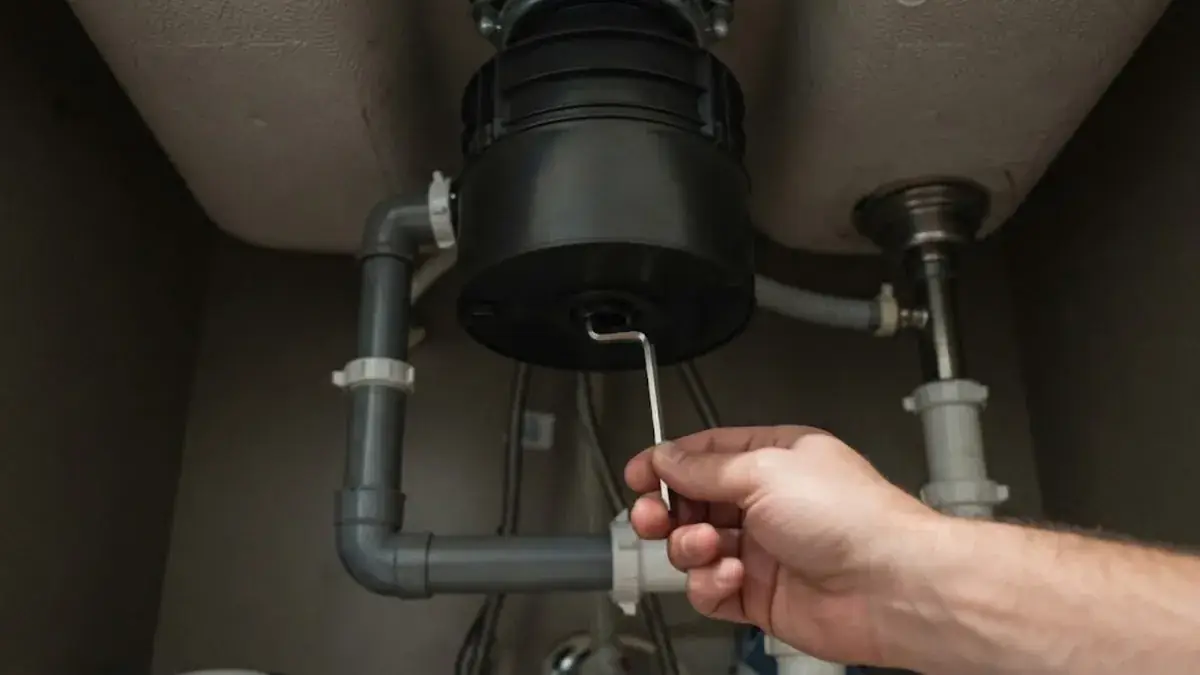
A garbage disposal that hums and does nothing is almost always jammed. The motor is trying to turn, but something is blocking the grinding plate. A silent disposal is a different problem, usually a tripped reset or a dead outlet.
These steps are safe if you follow the order. Never put your hand in the disposal, and always cut power first. If water is leaking from the unit, skip to the last section.
Humming, silent or leaking: what each one means
| Symptom | Likely cause | First step |
|---|---|---|
| Hums, will not spin | Jammed flywheel from a spoon, bone or fruit pit | Power off, free it with a hex key |
| Completely silent | Tripped reset button or breaker | Press the red reset, check the breaker |
| Spins but drains slowly | Partial clog in the drain line past the disposal | Run cold water, check the trap and line |
| Leaks from the bottom | Worn seals or a cracked housing | Usually replace the unit |
| Leaks at the top | Loose sink flange or mounting | Tighten or reseat the flange |
| Bad smell | Food residue in the grinding chamber | Clean the chamber and flush with cold water |
Free a jammed disposal in seven steps
- Cut the power. Switch off the wall switch and unplug the unit or flip its breaker. This is the step that prevents injuries.
- Look inside with a flashlight. Use tongs or pliers to remove anything you can see. Never reach in with your hand.
- Find the hex socket. Most disposals have a hex socket at the center of the bottom. Insert the wrench that came with the unit, or a 1/4 inch hex key.
- Work it back and forth. Turn the key until the flywheel moves freely in both directions, then remove the key.
- Press the reset. The red button on the bottom pops out when the motor overheats. Press it firmly until it clicks.
- Restore power and test. Turn the power back on, run cold water and switch the disposal on. Listen for a smooth spin.
- Flush the line. Run cold water for 30 seconds afterward to carry debris through the trap.
Chemical drain openers can damage seals and burn skin if the disposal backs up. Use water, a hex key and a plunger instead.
What should not go down a disposal
- Grease, oil and fat, which coat the line and cause clogs further down.
- Fibrous or stringy food such as celery, corn husks and artichokes.
- Bones, fruit pits and shells.
- Pasta, rice and potato peels in large amounts, which swell and gum up.
- Coffee grounds in quantity, which pack into a sludge in the trap.
Running cold water while the disposal runs, and for a few seconds afterward, helps carry waste through the line. Hot water melts grease briefly and lets it harden again further down the pipe, where it is harder to reach.
Hard water and your disposal
Shakopee Public Utilities rates the city water at 21 grains per gallon, which it calls very hard. Mineral scale builds up on grinding surfaces and in the trap and tailpiece, and it narrows the passage that waste has to travel through. A disposal in a hard water kitchen benefits from periodic cleaning of the chamber and the baffle.
Keep a disposal running well
A disposal works best when it is used a little at a time with plenty of cold water. Feed scraps in gradually instead of dumping a bowl at once, and let the water run for half a minute after the grinding stops. That clears the trap and the first stretch of drain line.
Citrus peels and ice are common home cleaning tricks, but they do not replace scrubbing the splash guard, which is where odors start. A small brush and dish soap do more than most products sold for the job.
If the unit is more than a decade old, humming and jams will come back. A new disposal is often cheaper than repeated repairs on an old one.
Write down the make and model from the label on the unit before you call. It tells the plumber whether a repair kit or a replacement is the practical choice, and it speeds up ordering parts.
Local notes for Shakopee kitchens
Shakopee Public Utilities states that city water is 21 grains per gallon. Scale on the splash guard and in the trap is a normal result, and cleaning it every few months helps keep flow clear.
A disposal that drains slowly in more than one fixture may point to the main line, which the homeowner owns from the house to the connection at the city main. See our sewer line cleaning page if several drains slow at once.
The Minnesota Department of Labor and Industry is the licensing agency for plumbers, and its Check a License tool lets you confirm a plumber before they work on your kitchen.
Source type: Shakopee Public Utilities residential water page and Minnesota Department of Labor and Industry
When to call a plumber
Stop the DIY and call if you see any of these
- Water leaks from the body or the bottom of the disposal.
- The hex key will not turn the flywheel at all.
- The reset trips again as soon as you press it.
- The disposal spins but the sink still backs up.
- You smell burning or see smoke.
Our garbage disposal repair page covers replacements and leak fixes. If the sink is backing up with no disposal noise at all, drain cleaning is the right call. Homes in Eden Prairie and Chaska are served on the same line.
Disposal drain and dishwasher connections follow the Uniform Plumbing Code (UPC) as adopted in Minnesota Rules chapter 4714.
Questions we hear
Usually not. A hum means the motor has power but the flywheel is stuck. Free it with a hex key and reset the unit.
On the bottom of the disposal, a small red button. If it keeps popping out, the motor is overheating and the unit may need replacement.
Cold water is better. It keeps grease solid so the disposal can chop it and carry it through the line.
Food residue sits in the chamber and on the baffle. Clean it with a brush and dish soap, and mineral scale from hard water can hold odors too.
Leaks from the body usually mean replacement. A loose flange or a worn gasket at the top can sometimes be fixed.
Not sure which answer fits your situation? Call the 24/7 line and describe what you see.