
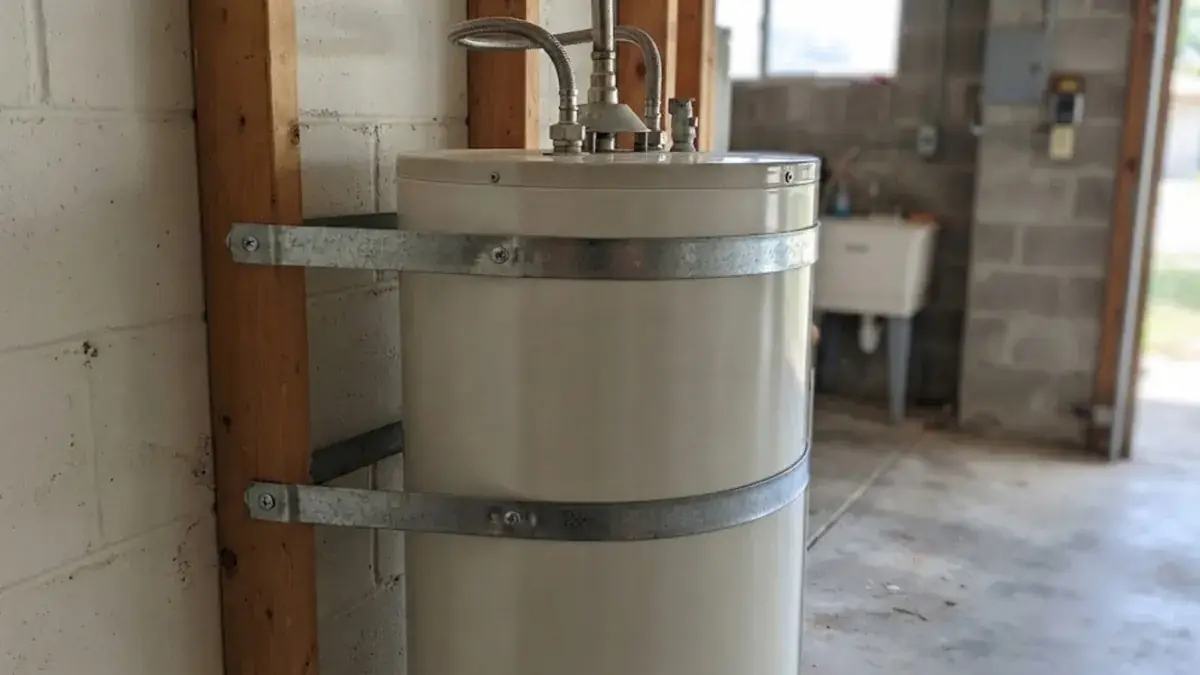
Weak or no hot water flow right after a heater replacement is common and usually fixable. The cause is often a partly closed valve, sediment knocked loose by the work, a clogged aerator or a kinked flex line. Rarely, the plumbing was already restricted and the new heater exposed it.
Work through the checks below in order. Start with the easy ones, because most fixes take minutes. If you smell gas, see leaking water or hear hissing near the heater, stop and call a plumber right away.
Is it hot, cold or both?
| What you notice | Most likely cause |
|---|---|
| Low flow at every hot tap only | Partly closed hot outlet valve, kinked flex line or clogged heater outlet |
| Low flow at a single hot tap | Clogged aerator or fixture cartridge |
| Low flow on hot and cold everywhere | Main shutoff partly closed, a pressure regulator problem or a utility issue |
| Sputtering and air bursts | Air in the lines after the work, which clears as taps run |
| Cloudy or gritty water | Sediment loosened during the swap |
Check these in order
- Open the valves fully. Make sure the cold supply valve at the heater and the main shutoff are both open all the way. Gate valves often stop a quarter turn short.
- Check the flex lines. Look at the braided connectors on the heater. A kink or a sharp bend can cut flow in half.
- Purge the air. Open a hot tap on the highest floor and run it for a few minutes. Open the others one by one.
- Clean the aerators. Unscrew the screen at the faucet tip and rinse out any grit. Sediment from the swap often lands here first.
- Flush the tank outlet. Close the cold supply and open a hot tap, then reopen the supply. The surge can push debris through.
- Check a pressure regulator. If there is a pressure reducing valve near the main, a plumber can test and adjust it.
Draining and refilling a plumbing system loosens scale and sediment that sat undisturbed for years. That debris travels to the first narrow spot it can find, usually a faucet aerator or showerhead.
If the pressure was already weak
A new heater cannot fix a restriction that was already in the lines. Galvanized supply pipes close down as mineral deposits build inside, and the effect shows first at the farthest fixtures. If every fixture is weak and the flex lines and valves check out, the supply piping may be the real problem.
That is a conversation about repiping, and a plumber can test flow at different points to see where the restriction begins. A pressure gauge at a hose bib gives a quick reading of what is arriving at the house.
Scale in Shakopee plumbing
Shakopee Public Utilities lists the city water at 21 grains per gallon, which it calls very hard. Hard water leaves mineral deposits in pipes and in the heater, and the work of draining and refilling can break those deposits free. A scale screen at the faucets and a yearly tank flush help keep the debris from building again.
How to measure pressure yourself
A simple hose bib pressure gauge, sold at hardware stores, screws onto an outdoor faucet and shows the pressure arriving at the house. Check it with other taps closed. A reading far below what is normal for the area, or one that swings widely, points to a regulator or supply problem rather than the heater.
Write the reading down with the date. If you need to call a plumber or the utility, a number is more useful than the words low or weak.
Compare the reading with the pressure at an indoor tap and you can often tell whether the restriction is outside or inside the house.
A short note on safety: if the relief valve discharge pipe drips steadily, or you smell gas, stop and call a plumber right away. Those are signs the new connections need a second look.
Local notes for Shakopee homes
Shakopee Public Utilities states that city water is 21 grains per gallon and is drawn from 17 wells between 218 and 800 feet deep. The utility adds fluoride and chlorine and does not describe softening on its residential page.
The utility also states that the homeowner is responsible for the line from the house to the connection at the main. If every fixture is weak and the heater checks out, a utility service call is a reasonable next step because the problem may start at the meter or the service line.
If your home is older and has galvanized pipe, a plumber can test the flow rate. Shakopee's lead and galvanized line inventory lists galvanized lines that require replacement, and the utility replaces those at no cost to the owner.
Source type: Shakopee Public Utilities residential water page and lead service line inventory
When to call a plumber back
Call if any of these apply
- There is a drip or spray at the new connections.
- The relief valve discharge pipe is dripping.
- Hot water flow is still weak after cleaning aerators and purging air.
- The water is brown or gritty for more than a day.
- Pressure is weak on both hot and cold at every fixture.
If you had the heater replaced by us or another plumber, call that company first because the fix may be a quick return visit. For a fresh look, see water heater replacement and water heater repair, or reach us for Prior Lake and Chanhassen homes.
Pressure reducing valves and relief valves are covered by the Uniform Plumbing Code (UPC) as adopted in Minnesota Rules chapter 4714.
Questions we hear
The restriction is on the hot side, such as a partly closed outlet valve, a kinked flex line or debris in the heater outlet.
For a short time, yes. Air gets into the lines during the swap, and it clears as you run each hot tap.
It can, because debris loosened during the swap collects in aerators and showerheads. Cleaning them often fixes it.
It is possible if pressure is weak at every fixture. Check your main and regulator, and contact the utility if the problem starts at the meter.
A plumber can measure flow and pressure at several points. A big drop between the main and a fixture points to a restriction in between.
Not sure which answer fits your situation? Call the 24/7 line and describe what you see.