
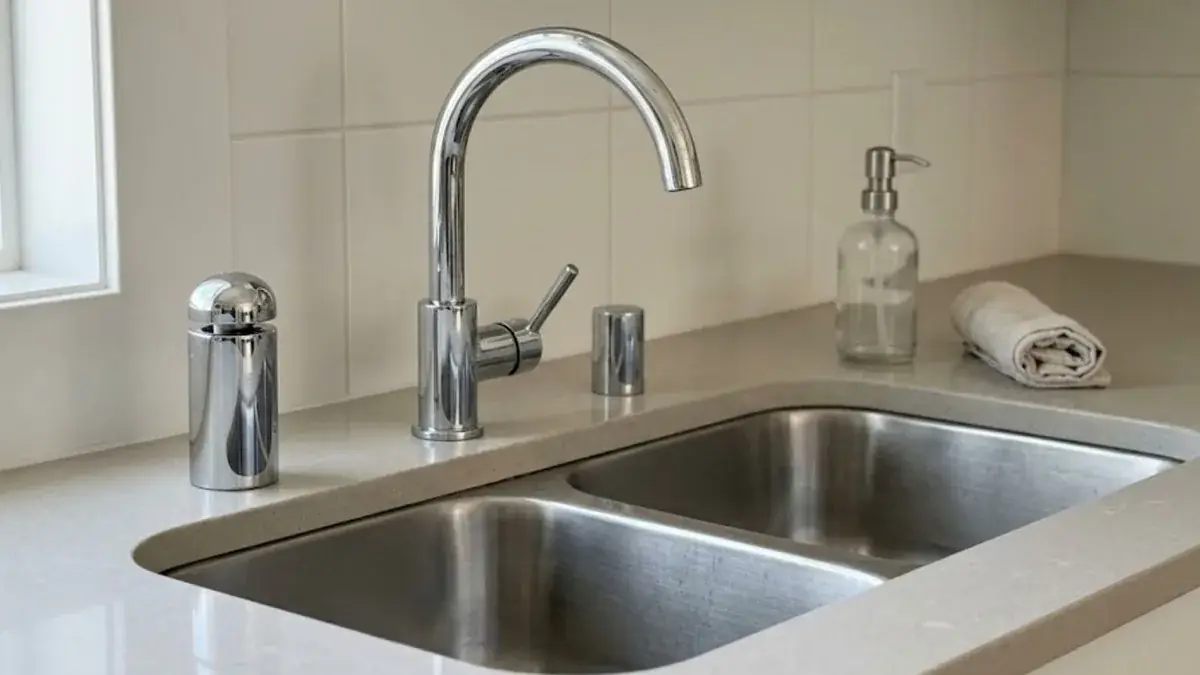
A double kitchen sink looks complicated underneath, but it is two basin drains joined into one trap and one line to the wall. Add a garbage disposal and a dishwasher and a few more connections appear, but the logic stays the same. This guide explains the parts, the order they connect and the mistakes that cause leaks and slow drains.
If you plan to do the work yourself, read to the end first, including the code section. If you would rather have a plumber do it, our plumbing installation page covers sink, faucet and fixture work.
The parts under a double sink
| Part | What it does |
|---|---|
| Basket strainers | Seal each basin drain to the sink and hold the tailpiece |
| Tailpieces | Short straight tubes that drop from each strainer |
| Continuous waste or tee | Joins the two basins into one line |
| P-trap | Holds a water seal that blocks sewer gas |
| Trap arm | Runs from the trap to the wall stub-out with a slight slope |
| Disposal (optional) | Replaces one basin strainer with a grinder, and has its own outlet and a dishwasher knockout |
| Dishwasher connection | A hose that goes to the disposal inlet or to an air gap and then to the drain line |
Plumb it in order
- Set the strainers. Seat each basket strainer in its basin with plumber putty or the supplied gasket, and tighten the locknut from below.
- Add the disposal, if you have one. Mount the disposal under one basin, then attach the discharge elbow to its outlet. Knock out the dishwasher plug inside the inlet only if a dishwasher will connect there.
- Connect the tailpieces and tee. Join the other basin tailpiece to a tee or continuous waste so both basins feed one line. The tee outlet should sit at the same height as the disposal elbow.
- Install the trap. Attach the P-trap below the joined line and connect the trap arm to the wall stub-out. The arm should slope slightly toward the wall.
- Connect the dishwasher drain. Run the dishwasher hose up into a high loop under the counter, or through an air gap if your local rules call for one, then to the disposal inlet or the tee.
- Test with water. Fill both basins, pull the plugs and check every joint for drips while the water runs. Tighten any joint that weeps.
A drain hose that sits low can let dirty sink water flow back into the dishwasher. A high loop, or an air gap if your local rules ask for one, prevents that.
Common mistakes that cause leaks and clogs
- Overtightening plastic slip nuts, which cracks them.
- Forgetting to knock out the dishwasher plug, which blocks the dishwasher drain.
- Using a long, sagging trap arm that collects debris.
- Skipping plumber putty or gaskets under strainers.
- Installing the trap too far from the sink, so the tailpiece run is longer than allowed.
Grease is the quiet clog maker. It coats the trap arm, cools in the line and catches food. A drain cleaning visit clears it, and a disposal repair visit handles a jammed or leaking unit.
Code basics and permits
Plumbing work in Minnesota is regulated, and the Minnesota Department of Labor and Industry is the licensing agency. Many cities require a permit for new plumbing work, and Shakopee building inspections lists a Plumbing Permit on its site. A like-for-like fixture swap may not need one, but adding a new fixture usually does, so ask before you start.
Venting is part of the code too. A trap needs air behind it, either through a vent in the wall or an approved air admittance valve, so a sink that gurgles or drains slowly may have a venting problem, not just a clog. Our installation page covers how a plumber checks this.
Before you start
Turn off the water at the stops under the sink and open the faucet to drain the lines. Put a bucket under the trap, because it holds water. Take a photo of the old setup before you take it apart so you can compare as you rebuild.
Dry fit every piece before you tighten anything. Most leaks come from a pipe that was cut slightly short or a washer that was set crooked, and both are easy to see before the nuts go on.
Local notes for Shakopee kitchens
The City of Shakopee building inspections page lists a Plumbing Permit and an ePortal for applications. It does not say which kitchen jobs need one, so ask the city before adding a new fixture or moving the drain.
The Minnesota Department of Labor and Industry is the licensing agency for plumbers, and it provides a Check a License tool on its site. Use it if you hire someone for the job.
Shakopee Public Utilities rates the city water at 21 grains per gallon, very hard. That leaves scale on faucets and strainers, so expect to clean aerators and strainer baskets more often than in a soft water town.
Source type: City of Shakopee building inspections page, Minnesota Department of Labor and Industry and Shakopee Public Utilities
When to hand it to a plumber
If the drain stub-out is in the wrong place, the trap will not line up, or the wall pipe is corroded, a quick sink job turns into a repair. A plumber can also check venting and slope, which are the two things most likely to be wrong in a DIY install. We also serve Savage and Prior Lake on the same 24/7 line.
Trap, vent and air gap rules for kitchen sinks come from the Uniform Plumbing Code (UPC) as adopted in Minnesota Rules chapter 4714.
Questions we hear
Not usually. Most double sinks join both basins into one line and share a single trap, which is the layout described in this guide.
Usually to the disposal inlet, or to the tee if there is no disposal. Use a high loop or an air gap if your local rules call for one.
The city lists a Plumbing Permit but does not detail which jobs need one. Ask building inspections before moving or adding fixtures.
Gurgling often points to a venting problem or a partial clog in the line. A plumber can check both.
Yes, but the disposal outlet should line up with the tee or continuous waste. Check the heights before you buy.
Not sure which answer fits your situation? Call the 24/7 line and describe what you see.