
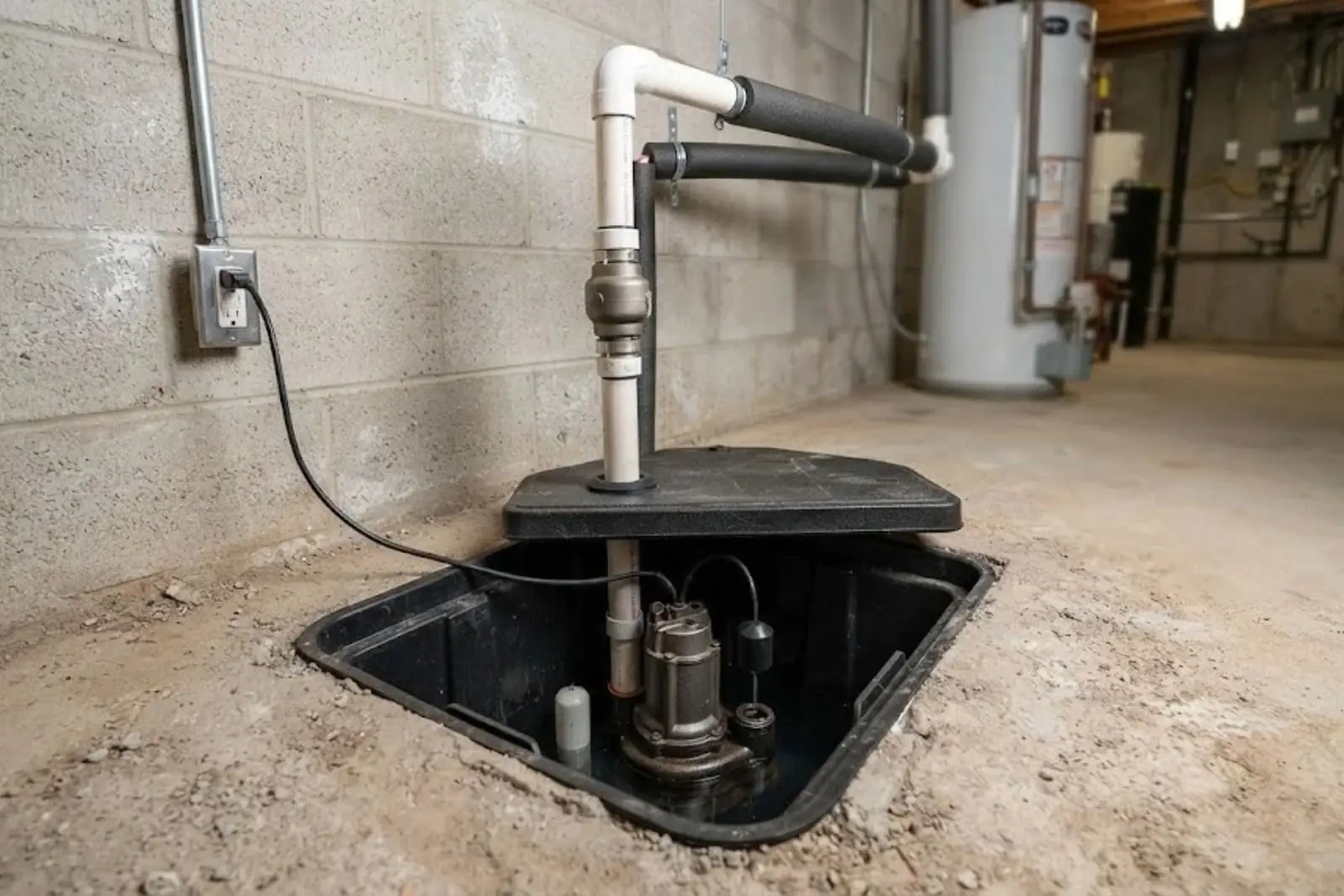
A sump pump that sits idle for months can fail the first time it has to run. Spring melt and heavy rain can raise groundwater around a foundation in a day or two, and the pump is what keeps it from reaching your basement floor. A short test in March costs nothing and can save a flooded basement in April.
This guide gives a simple checklist you can follow in about twenty minutes. If the pump fails any step, call a plumber before the water arrives.
Test the pump in five steps
- Look at the pit. Remove the lid and check for debris, gravel or sludge. Clean out anything that could jam the float or the intake.
- Pour in water. Fill a bucket and pour it into the pit slowly until the float rises and the pump starts.
- Watch it run. The pump should turn on, empty the pit and turn off without chatter or delay.
- Check the discharge. Make sure water leaves the house through the discharge line and runs away from the foundation.
- Check the check valve. Water should not flow back into the pit after the pump stops. A slapping sound means the check valve is working.
Check the whole system
| Part | What to check |
|---|---|
| Float switch | Moves freely, is not tangled or stuck against the wall |
| Power | Plugged into a working GFCI outlet, with no extension cord |
| Discharge pipe | Clear, not frozen and ending well away from the foundation |
| Check valve | Seated and working, with no backflow into the pit |
| Backup | Battery or water-powered backup tested and charged |
| Alarm | High-water alarm works, if installed |
| Pump age | Older pumps near the end of life should be replaced before they fail |
A discharge line that ends at ground level can be blocked by ice or a snow bank. If it is blocked, water backs up in the pit and the pump runs without moving anything.
Why a backup matters
Storms that raise the water table often knock out power. A pump with no power does nothing, and the basement fills while the electricity is off. A battery backup or a water-powered backup keeps pumping when the main pump cannot.
If the pump runs constantly, cycles on and off every few seconds or is noisy, it may be undersized or worn out. See sump pump repair for replacement and backup options. If water still reaches the floor with a working pump, basement waterproofing may be the longer-term answer.
How sump pumps work, briefly
A sump pit collects groundwater from drain tile around the foundation or from the soil beneath the slab. When the water in the pit rises, a float switch tells the pump to run, and the pump sends the water out through a discharge pipe. The check valve in that pipe keeps the water from running back in when the pump stops.
Every part of that chain has to work. A stuck float, a clogged intake, a frozen discharge or a failed check valve can each turn a healthy pump into a flooded basement. That is why the test above checks the whole chain and not just the motor.
Signs the pump is on its way out
- It runs much more often than it did last year.
- It makes grinding, rattling or humming noises.
- It shakes or vibrates in the pit.
- It runs without moving water or never shuts off.
- It is more than about ten years old.
Any one of these is a reason to plan a replacement before spring. A pump that fails during a thaw rarely fails at a convenient time.
Keep the area around the pit clear
Stored boxes and cleaning supplies near the pit get in the way when you need to look inside it. Keep the lid accessible and the floor around it clear, and keep a flashlight nearby. If the pit fills and the pump is silent, you will want to see inside quickly.
If you are buying a home with a sump pit, ask to see the pump run during the inspection. A pump that has been tested in front of you tells you more than one that is described as working.
Local notes for Shakopee and the river valley
Shakopee sits in the lower Minnesota River Valley. During the 2024 Minnesota River flooding the crest at Savage was among the top five on record, and Valleyfair's parking lot and three rides closed, according to local news coverage. Residents compared it with 1965.
Where your pump discharges matters. Ask the City of Shakopee whether a discharge line may connect to a sanitary sewer, because many cities restrict that, and keep the outlet away from the foundation and the neighbor's lot.
The City of Shakopee building inspections page lists a Plumbing Permit and an ePortal. Ask the city whether a new sump pump or discharge change needs one.
Source type: Local news coverage of the 2024 Minnesota River flood and City of Shakopee building inspections page
Have a plan for a failed pump
If the pit is full and the pump is silent
- Check the breaker and the outlet first.
- Unplug the pump and plug it back in after a few seconds.
- Make sure the float can move freely.
- Move belongings off the basement floor and away from the walls.
- Call the 24/7 line and tell the dispatcher water is rising in the pit.
We serve river-valley and lake homes in Savage and Prior Lake, where the water table is a regular concern, and the same checklist applies in every town on our list.
Where a sump discharges is a code question under the Uniform Plumbing Code (UPC) as adopted in Minnesota Rules chapter 4714 as well as a city one.
Questions we hear
At least once a year before spring, and again after a long dry spell. Pump failures often happen after it sits unused.
It is better not to. The pump should be on its own GFCI outlet to avoid trips and voltage drop.
Well away from the foundation, on ground that slopes away, and not into a place that freezes shut. Ask your plumber about your lot.
Many cities restrict it. Ask the City of Shakopee before connecting a discharge line to any sanitary line.
If it is old, noisy, runs constantly or fails the bucket test, replace it before spring.
Not sure which answer fits your situation? Call the 24/7 line and describe what you see.