Tankless water heaters work in Minnesota, but winter is the season that exposes a poor sizing choice. Incoming water is colder in January than in July, so the heater has to add more heat to reach the same temperature. A unit that handles two showers in summer may only manage one in winter.
This guide covers how inlet temperature affects flow, what to size for, where freeze risk shows up and what to check before you buy.
Why winter changes the math
A tankless heater has a maximum temperature rise, which is how many degrees it can add at a given flow rate. If incoming water is colder, the rise needed to reach 120 degrees is higher, and the maximum flow goes down. Manufacturers publish tables that show flow rate at different inlet temperatures.
| Factor | What to check |
|---|---|
| Inlet water temperature | Look up the flow rating at your coldest winter inlet temperature, not the summer figure |
| Simultaneous use | Count how many showers, appliances and taps run at once |
| Gas supply | A larger unit needs a larger gas line and meter capacity |
| Vent type | Condensing models use plastic vent pipe, and the terminal can ice over in extreme cold if it is poorly placed |
| Condensate line | Must drain without freezing, and sometimes needs a neutralizer |
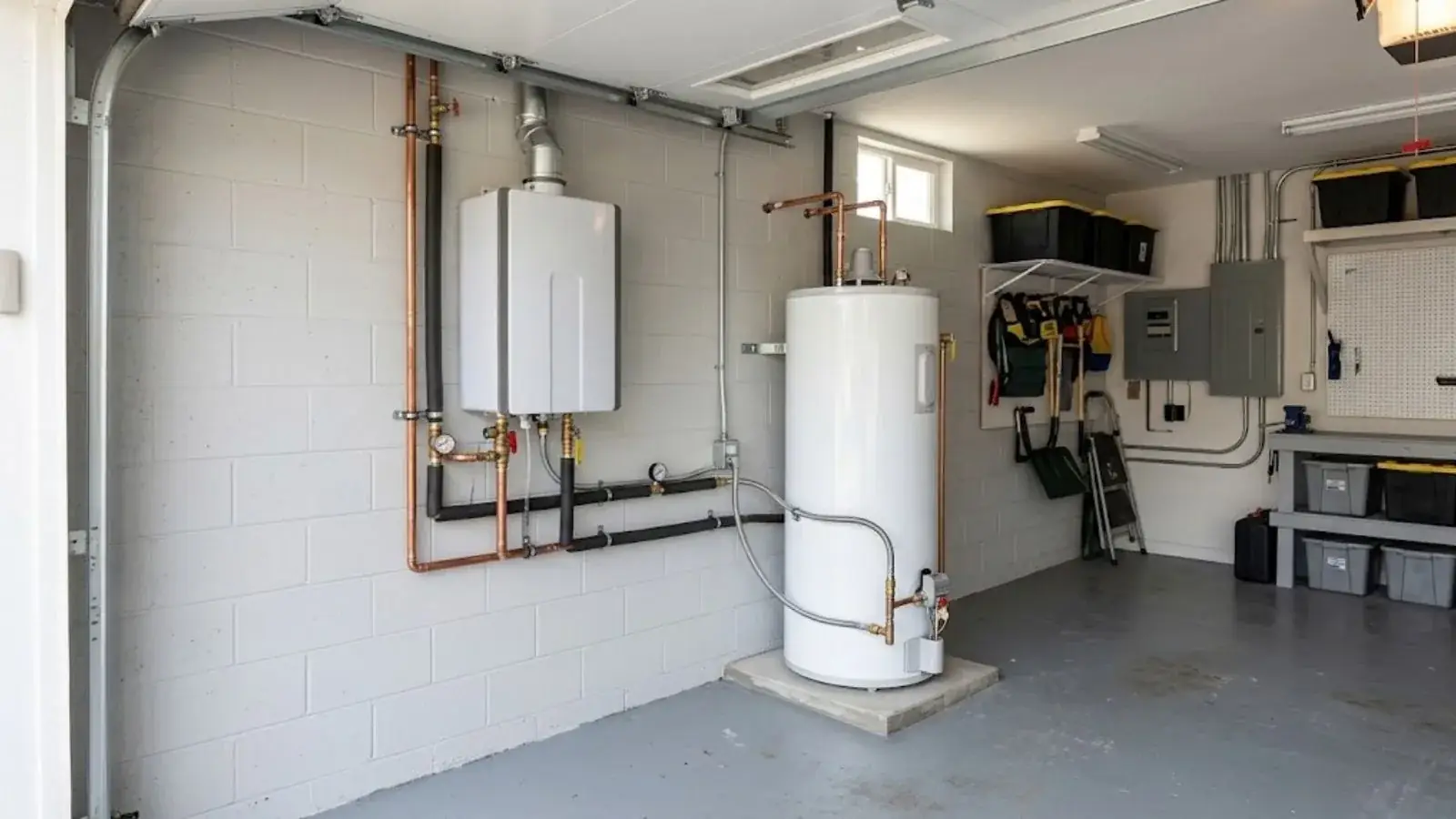
| Location | A garage or unheated space adds freeze risk to the unit and the supply lines |
Ask for the flow rating at the temperature your winter water actually reaches. If the unit is rated for a given flow only with a modest temperature rise, plan on the lower number for January.
Freeze protection
- Keep the unit in a heated space whenever possible.
- If it is in an unheated garage, check that the model has built-in freeze protection and that power stays on, because that protection needs electricity.
- Insulate supply lines and the condensate drain line.
- Know where the isolation valves are, so you can shut off and drain the unit if the power goes out for an extended period.
- Keep vent and intake terminals clear of snow drifts.
Power outages are the quiet risk. A tankless depends on electricity for its controls and its freeze protection, so a long winter outage with no power can leave water in the unit to freeze. A plumber can show you how to drain it safely if you are leaving for an extended time or the power is out.
Read the manufacturer's freeze protection instructions before you buy. Some models allow outdoor mounting with protection, and some do not.
Tank or tankless for a cold climate
A tank heater stores a full volume of hot water and delivers it at a steady rate until it runs out. A tankless delivers a steady stream as long as you stay within the limit, and it never runs out of stored volume. For a large household with simultaneous use in January, a tank can be easier to size, while a tankless works well when you choose the model for winter flow.
Our tankless water heater page lays out sizing, and water heater installation covers the options if you decide to stay with a tank.
A real-world way to test sizing
Add up the flow of everything you might run at the same time on a winter morning, such as a shower, the dishwasher and a bathroom sink. Compare that total with the unit's rated flow at your inlet temperature. If the total is higher, the unit will cool the water or cut flow when you use them together.
If you run short, the options are a larger unit, two units or a tank. A plumber can walk through the numbers with you, and it is easier to size correctly than to fix a shortfall later.
Remember too that fixtures with low-flow aerators or showerheads lower the demand and make a smaller unit workable.
If you already own a tankless and it struggles in winter, a plumber can check the inlet filter, the descaling history and the gas pressure. Those three account for many winter complaints and are cheaper to fix than a replacement.
Local notes for Shakopee installs
Shakopee Public Utilities states that its water comes from 17 wells between 218 and 800 feet deep. The utility does not publish a winter inlet temperature, so ask your installer to measure at a tap after the water has run for a minute in January, then size from the manufacturer's table.
The same utility rates the water at 21 grains per gallon, very hard. A tankless in hard water needs scale protection, covered on our water softener page, and a plan for descaling.
The City of Shakopee building inspections page lists a Plumbing Permit and an ePortal for applications. Ask your installer who pulls the permit for a tankless conversion.
Source type: Shakopee Public Utilities residential water page and City of Shakopee building inspections page
Questions to ask before you choose
A checklist for a Minnesota install
- What is the rated flow at our coldest winter inlet temperature?
- Is the gas line sized for this unit at full fire?
- Where does the vent terminate, and could snow or ice block it?
- How is the condensate drain protected from freezing?
- What happens if the power goes out in January?
These questions apply in every town we serve. Chaska and Chanhassen homes are on hard water too, and the same sizing logic applies.
Venting and condensate rules for tankless units come from the Uniform Plumbing Code (UPC) as adopted in Minnesota Rules chapter 4714 and the maker's instructions.
Questions we hear
It can if power fails or the freeze protection is missing. Choose a unit rated for the location and keep the power on, or install it in a heated space.
Colder incoming water means the unit needs a larger temperature rise. If it is at its limit, the output temperature or the flow drops.
It needs a more careful look at winter flow, but the tables are published and a plumber can do the math with you.
If the home will be unheated or the power will be off, yes. Ask your plumber to show you the drain valves.
Scale builds the same all year, but cold weather masks it because you may already be near the unit limit. Descale on the maker's schedule.
Not sure which answer fits your situation? Call the 24/7 line and describe what you see.