
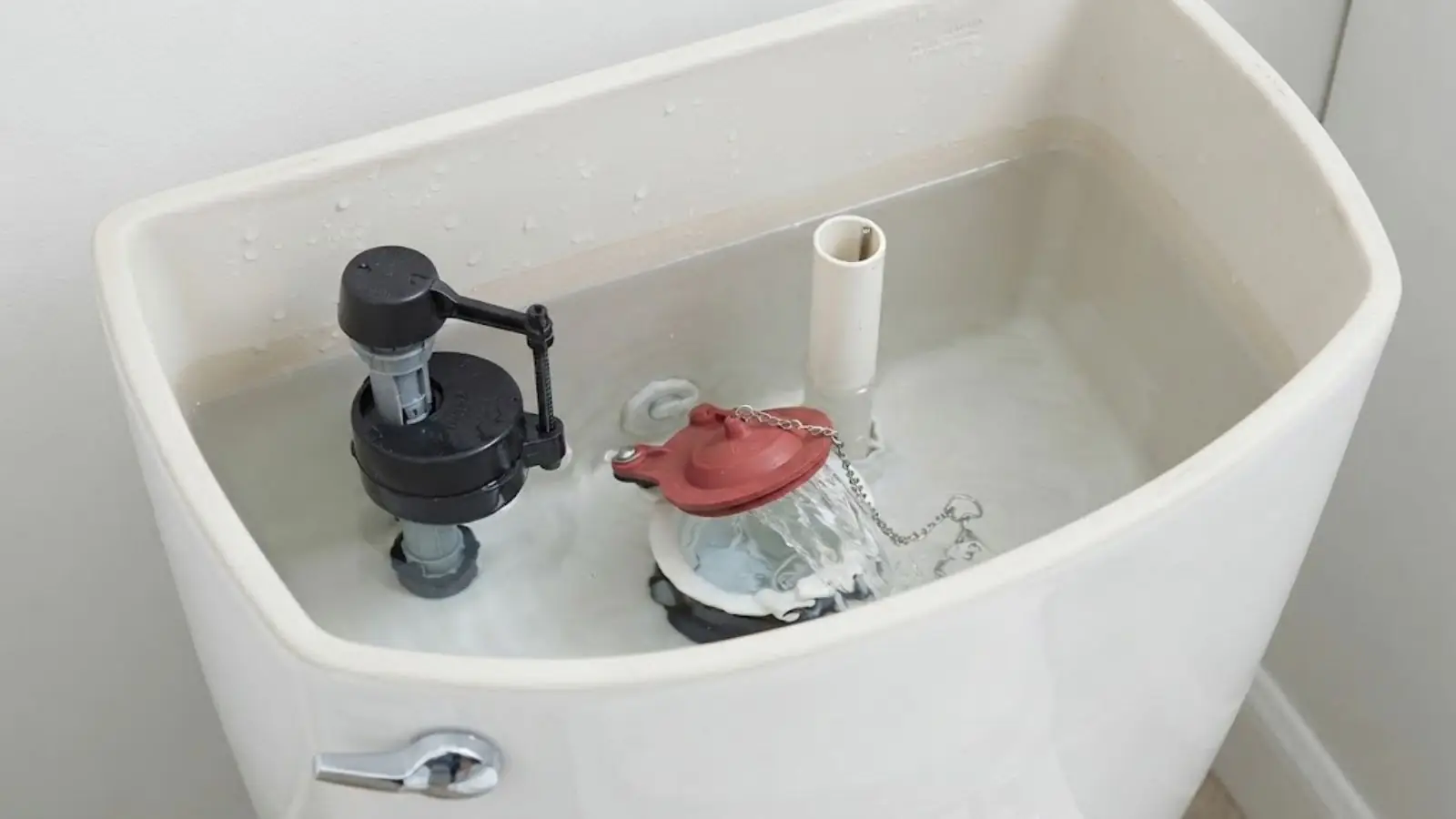
A toilet that hisses, refills on its own or runs for minutes after a flush is wasting water around the clock. In most cases the fill valve (the tall assembly on the left of the tank) or the flapper (the rubber seal at the bottom) has worn out. Both parts are cheap, and replacing a fill valve is a job most homeowners can finish in under an hour.
This guide helps you work out which part is failing, then walks through a fill valve swap step by step. If the toilet is cracked, leaking at the base or backing up, that is a different job and a plumber should look at it.
Is it the fill valve or the flapper?
| What you notice | Likely cause |
|---|---|
| Hissing or trickling when the tank looks full | Fill valve not shutting off, or water level set too high |
| Water running down the overflow tube | Fill valve water level set too high, or a failing valve |
| Tank refills on its own every few minutes | Flapper leaking water into the bowl |
| Handle must be held down to flush | Chain too short or long, or a worn flapper |
| Slow, noisy refill | Clogged valve or partly closed supply stop |
A simple dye test separates the two. Drop a few drops of food coloring into the tank and wait about fifteen minutes without flushing. If color shows up in the bowl, the flapper is leaking. If the tank is full and the water keeps running, the fill valve is at fault.
Tools and parts
- A new universal fill valve, sized to your tank height
- An adjustable wrench or channel locks
- A small bucket and a sponge or towel
- A new braided supply line if the old one is stiff or corroded
- A tape measure to match the valve height to your tank
Replace the fill valve in six steps
- Shut off the water. Turn the oval or round handle on the wall or floor stop clockwise until it stops. Flush once to empty the tank.
- Sponge out the rest. Use the sponge and bucket to remove the last water from the tank bottom.
- Disconnect the supply line. Unscrew the nut at the bottom of the tank under the valve. Have the bucket ready because a little water will spill.
- Remove the old valve. Unscrew the large nut under the tank that holds the valve in place, then lift the valve out from inside the tank.
- Install the new valve. Set the new valve in the hole, set its height as the instructions show so the top is above the overflow tube, and hand tighten the locknut. Do not use a wrench on plastic nuts.
- Reconnect, refill and adjust. Reattach the supply line, open the stop slowly, check for drips and set the water level to the mark in the tank.
Overtightening plastic nuts cracks the tank. Hand tight plus a small extra turn is enough, and tightening a little more after the first fill is better than breaking the tank.
What a running toilet costs
A toilet that runs steadily can waste a lot of water over a day, and the bill does not care whether the water went to a flush or the drain. Homeowners in Shakopee should know that the utility bills for all water used, including water lost to leaks, so a quiet running toilet shows up on the bill before it shows up anywhere else.
If your bill jumped and you cannot find a leak, a running toilet is the first fixture to check. If the toilet is fine and the usage is still high, move on to a leak detection visit to check for a hidden line.
A quick check of the flapper too
While the tank is open, lift the flapper and feel its edge. A flapper that is soft, sticky or covered in grit will leak slowly even with a new fill valve. Clean the seat with a cloth and replace the flapper if it looks worn.
Local notes for Shakopee toilets
Shakopee Public Utilities states that the homeowner pays for all water used, including water lost through leaks. A constantly running toilet is one of the cheapest leaks to fix and one of the easiest to miss.
The same utility rates its water at 21 grains per gallon, which it describes as very hard. Mineral deposits can foul fill valve seats and flapper edges, which is one reason these parts wear out sooner in hard water areas.
Whether you replace the valve or call for help, shutting off the stop under the tank is the fastest way to stop an active leak.
Source type: Shakopee Public Utilities residential water page
When to stop and call a plumber
Signs this is more than a fill valve
- The shutoff stop will not turn or leaks when you touch it.
- The tank or bowl is cracked or water appears at the base of the toilet.
- The toilet rocks, which can mean a failed wax ring or loose flange.
- Water keeps running after a new valve and flapper are installed.
- The toilet backs up or gurgles along with other fixtures.
Our toilet repair service covers wax rings, flanges and cracked fixtures. If water is spilling or the stop will not close, call the 24/7 line. Homes in Chanhassen and Chaska are on hard city water too, and the same fix applies.
Fill valves in the United States are expected to include anti-siphon protection under plumbing codes such as the Uniform Plumbing Code (UPC), so choose a valve marked for that.
Questions we hear
There is no fixed lifespan. Hard water, chemical tank cleaners and age shorten it, and many homeowners replace one when it starts to hiss or the water level will not stay set.
It is a good idea if the flapper is soft, warped or stained. Fill valve and flapper kits are cheap and replacing both avoids a second repair.
Yes. The utility bills for water used, including leaks, so a quiet running toilet adds to the bill even if no water touches the floor.
The water level may be set too high, so water spills into the overflow tube. Lower the float until the level sits at the mark in the tank.
Yes, if it turns freely. If it is stuck or leaks, do not force it. Shut off the main and call a plumber.
Not sure which answer fits your situation? Call the 24/7 line and describe what you see.